
Against 'Form'
But seriously, f*ck form.

It’s common to say a player playing well is ‘in form’ or a team on a poor run of results is ‘out of form,’ a team on a good run is the ‘form team in the league’ and a player having a rough time is ‘struggling to find his form.’ In these usages, ‘form’ looks like an innocuous way of describing a streak of good or bad play, but I think it’s not so innocuous.
Here’s an example of why. By now it’s notorious that Spurs closed out the season by losing 5 of the last 7 games. Cue commentary about the team’s ‘terrible form.’ Contrast with Chelsea, who ended the season as the ‘form team’ in the Premier League, with 5 wins in the their final 5 matches.
But these starkly different runs of ‘form’ hide a simpler and more precise fact about each club’s results: Spurs just played against much better competition (Newcastle, Arsenal, Chelsea, Liverpool, Burnley, City, and Sheffield) in their final run of matches than did Chelsea during their end-of-season streak (Spurs, West Ham, Forest, Brighton, Bournemouth). Of course Chelsea have some tough games in their run-in and Spurs have some relatively easy ones in theirs, but on the whole what explains the difference in ‘form’ between the two is significant difference in the quality of competition in the run-in.
My point here is not to make excuses for Spurs’ or anyone’s run-in, but simply to show that usually when people use the word ‘form’ to describe a team or a player, they’re mystifying what’s really happening, as if there’s some magic dust in the air that settles on some teams and not others and produces ‘form.’
How much does this matter? Well, in most cases, probably not much. But I’m sure you’ve witnessed scenarios—as above—in which discussion of a team’s or player’s ‘form’ instead of data or other relevant factors that better explain what’s happening becomes a way of introducing bias or prejudice into coverage and analysis.
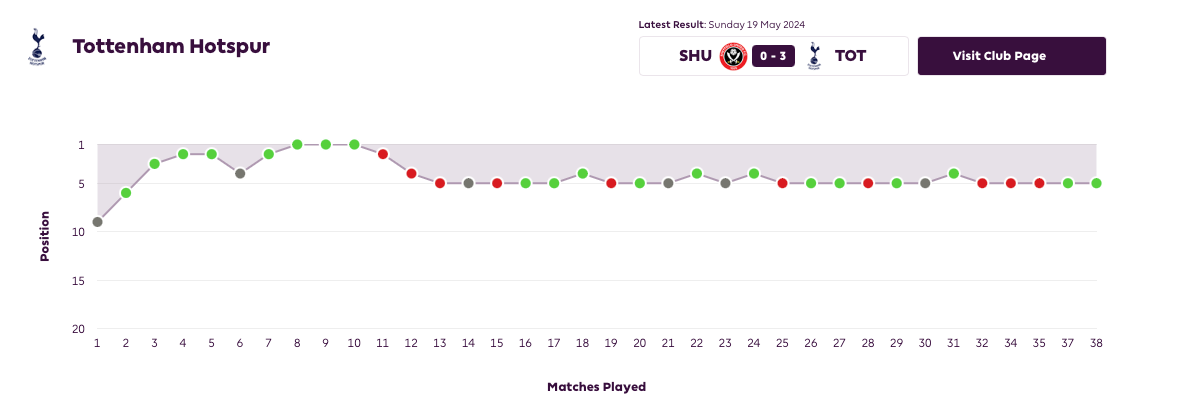
Taking Spurs as an example, we’ve been harangued in the press all season about Spurs’ ‘inconsistent form,’ but how many teams in the Premier League have held their league position more consistently than Spurs, who’ve been either 4th or 5th from Week 13 all the way to Week 38? We can quibble over performances and add context to this picture—the injury and suspension crisis after the Week 11 lost to Chelsea—but that’s just more grist for good explanation of the season than relying on ‘form.’
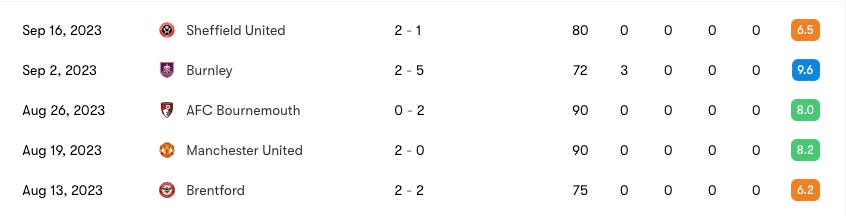
The use of ‘form’ to mystify and muddle works just the same for players. Take Son Heung-min, for example. After a strong start to the season, we’re told his ‘form’ fell off a cliff in the second half. ‘Ball is bouncing off him,’ etc. Taking FotMob ratings as a proxy, Son averaged 7.8 rating over his first 10 Premier League games of the season, scoring 8 goals and assisting 1, for a total of 9 G+A.
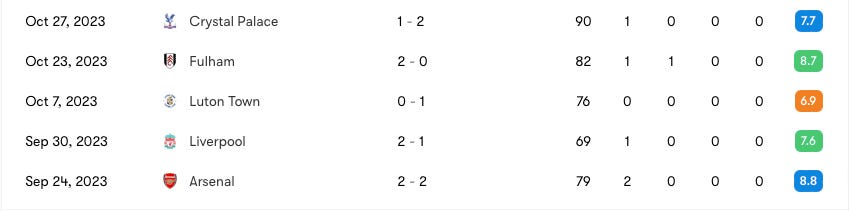
His average FotMob rating for the final 10 Premier League games of the season was a bit lower at 7.4, during which stretch of games he scored just 3 goals and assisted 2, just over half his G+A production in the first 10 games.
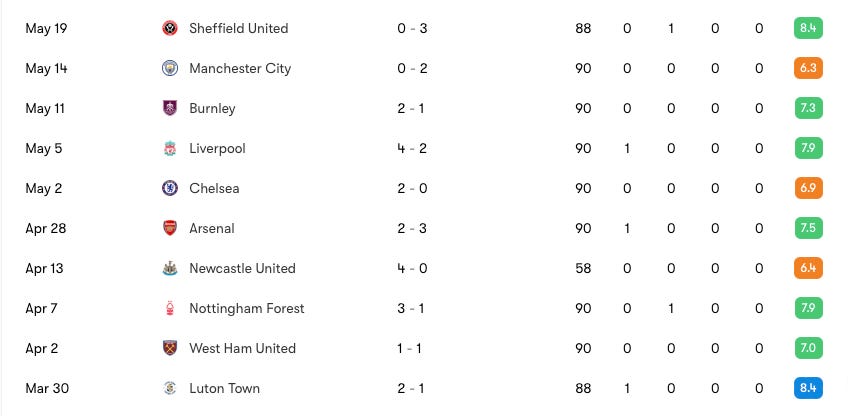
From this information we can see pretty clearly that Son had a significantly better start to the season than end to the season, so at first glance it might look like descriptions of his ‘form’ have been correct.
But they haven’t been correct! And here’s why. Once again, ‘form’ mystifies what we can explain better without it. The FotMob rating, which aggregates more than 300 individual statistical categories from Opta, is a proxy for overall player performance. The difference between Son’s first-10 rating (7.8) and his last-10 rating (7.4) is about the difference between Rodri (8.1, top in the Premier League) and Declan Rice (7.7), which is to say we’re not talking about terribly different levels of performance (Son finished the season with a rating of 7.5).
So, what really stands out between Son’s first-10 performances and last-10 performances is the difference in goals scored. When we’re saying he’s 'in form’ or ‘out of form,’ what we’re really saying is he’s scoring or not scoring goals. But whereas ‘form’ generalizes and mystifies Son’s relatively consistent performances across the season—at least as sampled here in his first and last 10 games—it’s more precise and gives you better information to simply say ‘he’s not scoring as many goals.’
And it’s much easier to generalize from that specific data point (difference in goals scored over two different periods) than to generalize from a generalization like ‘form.’
And that’s why I think: f*ck form.