
Holding Pattern
Tottenham Hotspur are stuck again.

In the 2022-23 season, Spurs finished 8th in the Premier League, their worst league finish since 2008-9. The club sacked Antonio Conte during the March international break, leaving the squad to his assistant, Christian Stellini, then to Ryan Mason for the final 6 games of the season after sacking Stellini. Prior to taking over full-time, Stellini covered for Conte (who was back in Italy undergoing gallbladder surgery), seeing Spurs out of the Champions League tie against AC Milan with a 1-0 loss and a 0-0 draw—two of the worst football matches any of us had ever watched—and crashing out of the FA Cup in the 5th round, losing to Sheffield United.
The period after Conte’s sacking stands out for me as one of the bleakest times at Spurs in recent memory, not because we were in any particular jeopardy, but because the club and the squad seemed rudderless, void of ideas about who we were and where we were heading, and in no position to do anything about it.
In other words, we were in a holding pattern, a joyless in-between during which there was still more than a quarter of the season left and we were scrambling under caretaker management every week. Regardless of your views on Conte—I liked him more than most—it was pretty clear back then that once the club sacked him, the remainder of the season was a write-off, a frustrating exercise in stasis.
Now 25 games into the 2025-26 Premier League season, I think Spurs are in another holding pattern and, as always, I think it’s useful to look to the past for instructive context.
With Conte still at the helm 25 games into the 2022-23 season—just 3 games before he was sacked—Spurs sat 4th in the league table on 45 points, having scored 45 goals and conceded 35, with a GD of +11:
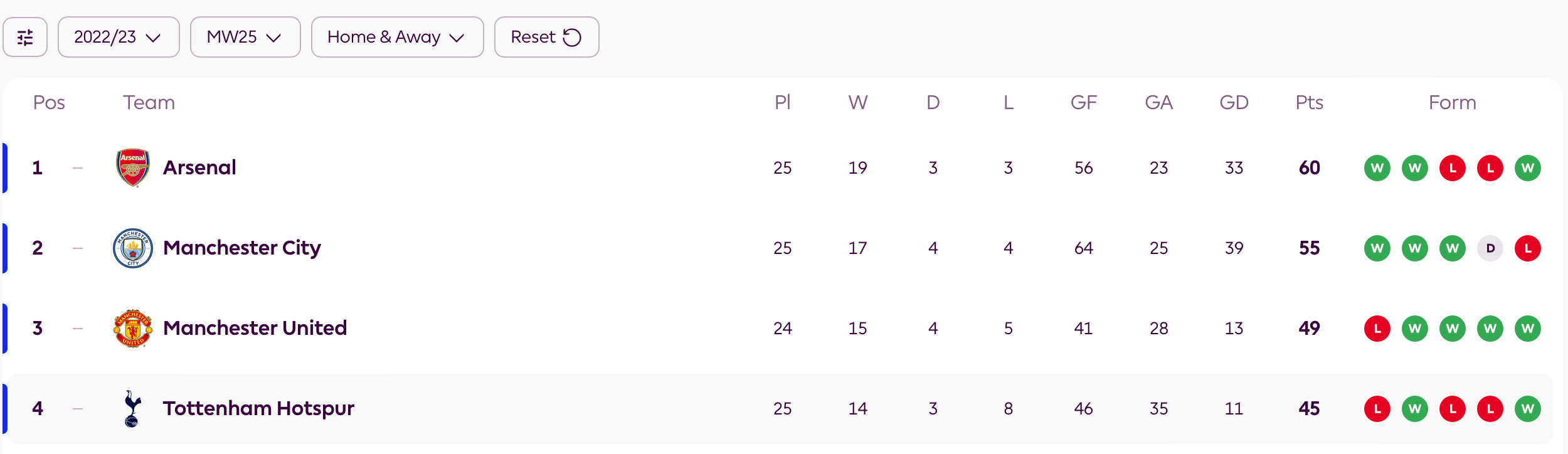
That’s an average of 1.8 points per game. After Conte was sacked—which came after 28 Premier League games, the 28th being that horrific 3-3 draw to Southampton and Conte’s subsequent fireworks in the post-match presser—Spurs played 10 Premier League games to finish out the season. From those 10 games we took 3 wins, 5 losses, and 2 draws, for a total of 11 points, or 1.1 points per game. The downward shift even from a beleaguered side under Conte was unmistakable, as was the feeling among much of the fanbase that we just wanted the season to end.
That was still enough to finish 8th, in large part because Spurs had already accumulated enough points under Conte to keep us firmly in the top half of the table. Spurs in 2022-23 had more than 50% more points through 25 matches than we do now.
In fact, if we look at the first 25 Premier League matches in each season since 2022-23, our performance this season under Frank has been not only the worst in terms of points gained, league position, and goal difference, but also the most dangerous in terms of relegation proximity.
Goal difference is a particularly striking stat in this comparison, because even the struggling Conte and Postecolgou sides scored far more goals than they conceded through the first 25 games—GDs of +11 in Conte’s second season, +14 in Postecoglou’s first season, and +12 even in Postecoglou’s second season—whereas Frank’s Spurs this season, with a GD of 0, look like we actually deserve our league position:

Holding Pattern Characteristics
The reason I’m comparing the first 25 games of this season under Frank to the decline of the Conte era in 2022-23 and the caretaker spell of that season is these stretches of games have distinct holding pattern characteristics.
By ‘holding pattern characteristics’ I mean both the evidence and the sentiment around the club and performances indicate a lack of progress and a lack of prospects for improving under current conditions. Even with some variation in outcomes, like the odd win or snatched draw, it feels like Groundhog Day, only on a bad day.
We know this because, as was the case for the first 25 games in 2022-23, 2023-24, and even 2024-25, we were furnished with evidence that systems under Conte and Postecoglou yielded top-end results with healthy squads. In their downfalls, both managers dealt with injury crises the likes of which Frank is now also dealing with (Conte to a lesser extent, perhaps, than the other two managers, though his tenure was certainly when we started talking of injury crisis and overtraining), but what’s different for Frank this season is that we’ve seen neither success nor any semblance of progress even during the healthy periods. It would be fair to point out that Frank has never had the benefit of Son, Maddison, or Kulusevski, though in return I’d say Conte never had two wingbacks and Postecoglou never had Kane, nor any cover for injuries to Romero, van de Ven, Solanke, Odobert, etc. with the likes of Kudus, Xavi, Kolo Muani, and Palhinha.
Even the claim that Frank has stabilized Spurs’ defense, raised our floor, and made us more defensively solid has proven fatuous. The 35 goals we’ve conceded in the Premier League thus far is the same as Conte’s Spurs conceded 25 games into 2022-23, and just 2 fewer than Postecoglou’s Spurs conceded 25 games into last season. However, the anemic 35 goals Spurs have scored so far this season is dramatically lower than the 46 under Conte, much less the 52 and 49 under Postecoglou. Instead of raising the floor, we’ve lowered the ceiling.
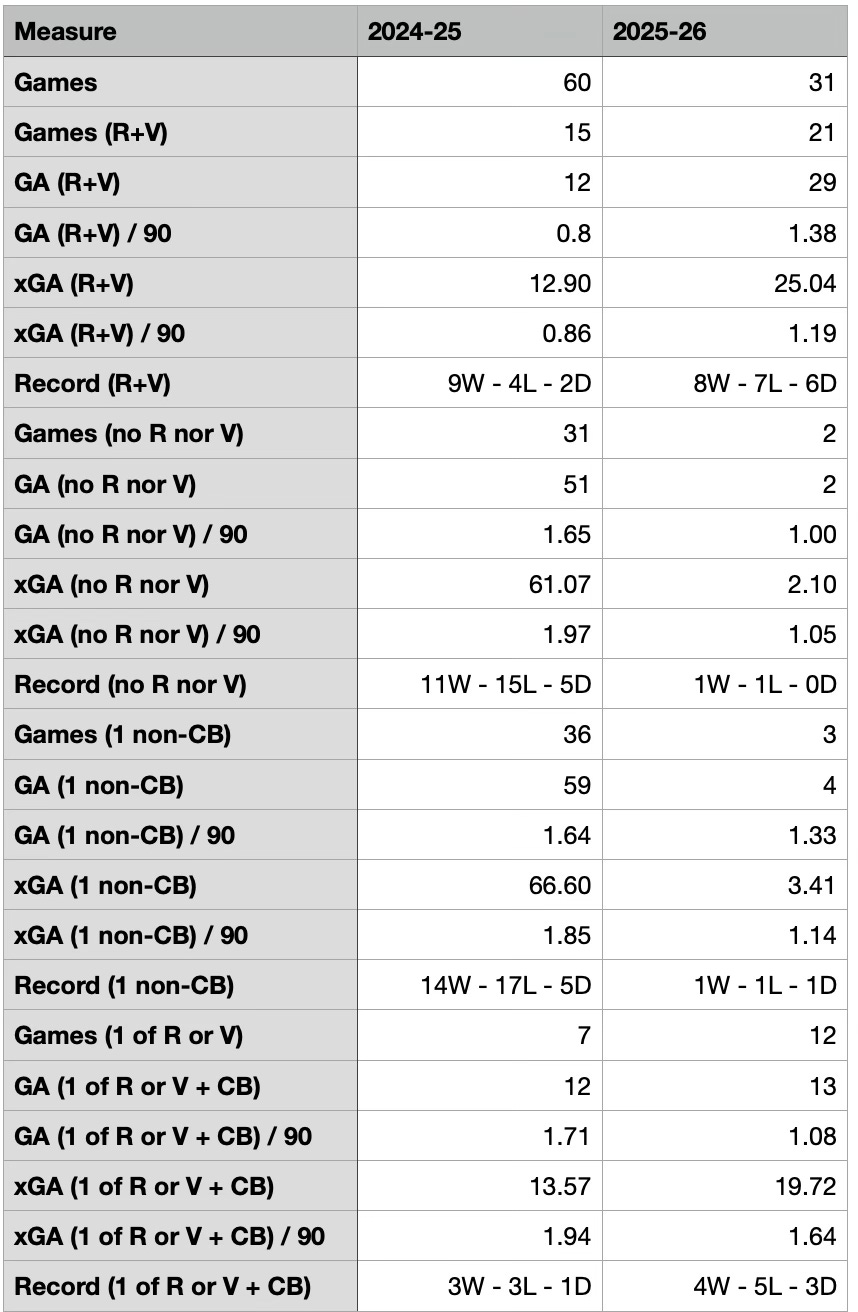
We can see how wrong the ‘Frank has stabilized Spurs’ narrative is with more granularity by looking at our defensive performance this season with different center back combinations compared with last season. For example, Frank has had the benefit of the Romero and van de Ven pairing 21 times in all competitions this season, which is already 6 more times than Postecoglou had them all of last season. Yet the pair has performed worse under Frank this season than under Postecoglou last season, averaging 1.38 goals conceded per game (versus .8 last season); 1.19 xGA (versus .86); and securing just 8 wins in 21 games (versus 9 wins in 15 last season).
We can also see that although Frank has recently been forced to use Palhinha—a non-CB—at center back for one half of a football match so far this season, Postecoglou was forced into using at least one non-CB at CB 36 times last season (!), or 60% of the time. Whereas last season Postecoglou had the benefit of being able to use one of Romero or van de Ven just 7 times, Frank has already had the use of one or the other 12 times. While Frank has done a bit better with that situation, averaging 1.08 GA per 90 and 1.64 xGA per 90 (compared with Postecoglou’s 1.71 GA per 90 and 1.94 xGA per 90), it’s still not good, and it’s arguably with better defensive personnel (Danso instead of Dragusin, Vicario instead of Forster and Kinsky, Palhinha sitting in front of the CBs).
Zooming out, if you look at Spurs’ xG, xGA, and chance creation so far this season, you get a similar picture of decline from prior seasons, with nothing to suggest the likelihood of improvement. Spurs have had a superior goal difference against our opponents just 15 of 36 times this season in all competitions, and just 9 of 25 times in the Premier League. Meanwhile, in all competitions, we’ve slightly outperformed a league norm of 35% big chance conversion, while our opponents have taken just 27% of their big chances against us, meaning our chance creation and concession are both worse than the poor outcomes we’ve witnessed thus far.
More alarming still, of the 42.5 cumulative xG Spurs have generated this season in all 36 competitions (1.18 xG per 90), 15.6 xG has come from our 9 matches against non-Premier League competition (1.73 xG per 90). Taking away our domestic cup matches against Newcastle (.83 xG) and Villa (.76 xG) in addition to all the matches we’ve played against non-PL opponents, we’re left with a Premier League cumulative xG of just 25.31 over 25 games (1.01 xG / 90). That puts us 17th in the Premier League, about where we’ve been all season in that metric.
These are just additional ways of saying that under Frank, Spurs have been consistently poor in the Premier League. We’re defending as poorly as last season with fewer defensive injuries and more defensive cover; our attacking has been dramatically worse with comparable attacking injuries to last season but substantially more attacking cover; and our actual results through 25 Premier League games are worse than ever.
This degree of consistency—of being consistently bad—is what makes this season feel like another holding pattern. We have 13 more league games (compared with the 10-game remainder after Conte was sacked in 2022-23) and appear wholly inert in the face of how poor we’ve been. The club did little to strengthen the injury-plagued squad in the January transfer window, just like last season. And the conversation among fans and pundits has shifted to whether we should consider ourselves a relegation risk, again without any indication from the club’s senior executives that they have any intention of making a managerial change.
Now, we wait. The time has long since passed to salvage much from this season in the league, at least according to the standards we’re accustomed to. Because Frank has less of a cushion above the relegation zone than Postecoglou had last season, he can’t afford to do what Postecoglou did and gamble all of his chips on the Champions League, resting key players in league matches for the final third of the season. He doesn’t seem the type to take that kind of risk anyway.
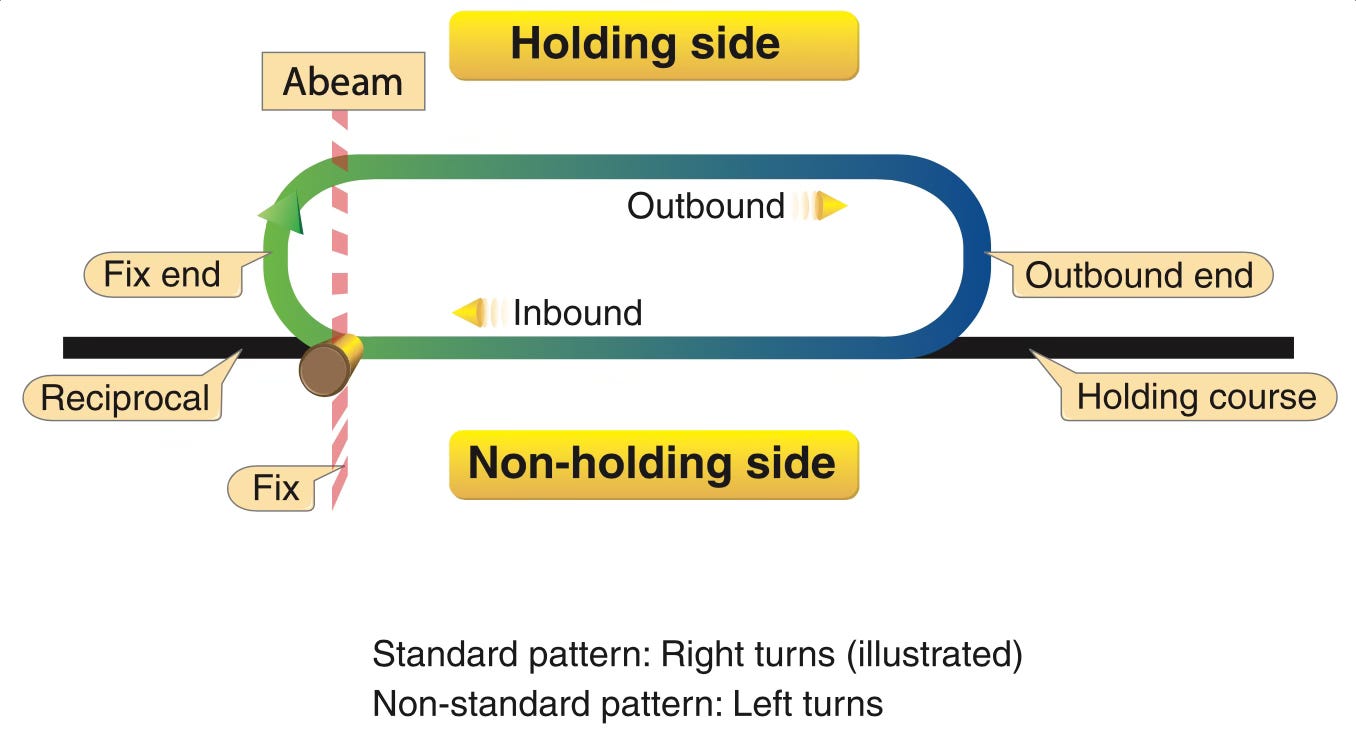
What this amounts to is very little prospect for change or adjustment between now and the end of the season, no obvious moves to change the situation, at least none that seem at all plausible at this point. Likewise, on the pitch, we have little evidence (if any) that the combination of Frank and this squad will be able to turn things around to the degree necessary to move into the European places. I’d love to be wrong about this, of course, but it’s hard to do much more than hope and wait. For me, it’s like circling Heathrow on the redeye, restless in my chair, eager for stimulus.
Spot on analysis
I thought Frank was going to be a good tactician... I am still waiting.