
It's the Expectations, Mate
The higher you go, the thinner the air.

After consecutive derby losses to Arsenal and Chelsea just days apart, it’s hard to feel good about the direction of this Tottenham team under Ange Postecoglou. Against Arsenal at home, Spurs were compelling, even dominant, but still managed the highly improbable, conceding 3 goals on .7 xG worth of opportunity for Arsenal. That was mostly down to baffling set-piece organization. An effervescent start with plenty of the ball went flat the moment an Arsenal corner kick sailed over the head of 5’9’’ front-post man Pedro Porro (???) and off Hojbjerg’s noggin for an own goal.
That might not have felt so deflating if conceding on defensive set pieces weren’t among the most consistent things this Spurs side have done all season (and indeed, if we hadn’t conceded again on a corner just 20 minutes later). Somehow we’ve managed to take one of the most orchestrated and controllable aspects of an otherwise chaotic game and turn it into a bleak inevitability.
What happened next at Stamford Bridge isn’t worth commentary.
So where are Postecoglou’s Spurs heading, and how should we think about it?
You measure the journey from where you started.
Last season, in which Spurs finished 8th in the Premier League and out of the European spots for the first time in 14 years, was both an anomaly and the culmination of a trend. You can’t understand where Spurs are now and where we’re going without understanding both of these components of where we’ve come from.
First, the anomaly:
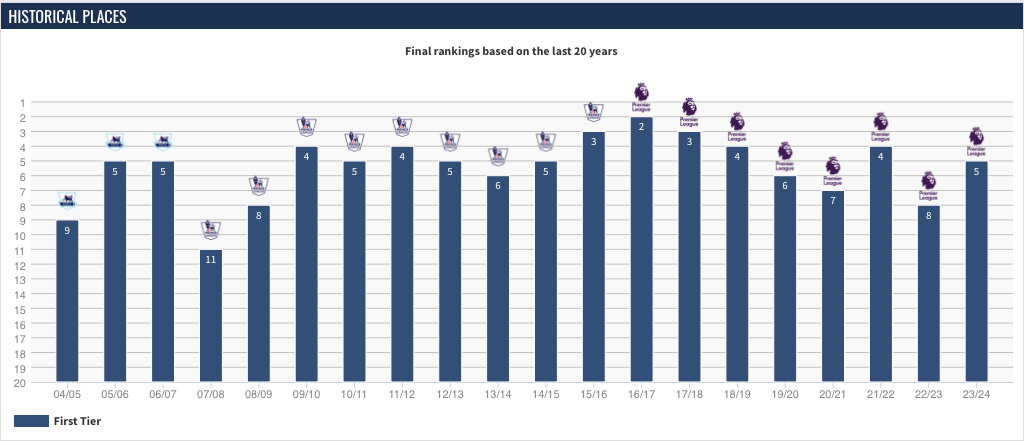
Spurs hadn’t finished as low as 8th since 2008-9. In the 15 seasons since then (including our current season and league position), our average league finish has been between 4th and 5th place (4.7).
But that’s not the only thing that makes last season anomalous. Despite all the chaos, the injury crises for a squad too thin for the Champions League, the 3 different managers, the life-saving emergency surgery, the death of one of our coaches, and of course the Harry Kane saga, people tend to forget that there was a World Cup in the middle of the season, and our players played the 2nd most minutes in it out of any team in the Premier League. For perspective, look at the injuries that Newcastle have dealt with this season with a squad similar in size, depth, and quality to Spurs’ squad last season, fighting in the UCL, the cup competitions, and the league simultaneously. Now imagine the majority of Newcastle’s best 13 also played regularly for their countries in a mid-season World Cup.
8th place was a false level.
The fact that Spurs finished 8th in an anomalous season and lost the best striker in the world to Bayern Munich over the summer has tricked a lot people into believing we’re in the midst of a deep, painful rebuild. Pundits not worth naming even went so far as to say Spurs would be mid-table at best, maybe even fighting relegation this year without Harry Kane.
But that was always wrong, because 8th place was a false level to begin with. What we really have is a 4th-5th place squad coming off the hangover of an anomalously poor season. But it’s not just any 4th-5th place squad. It’s a 4th-5th place squad built over three years of managers before Postecoglou who didn’t particularly value the kind of technical ability that makes a Postecoglou team tick.
And that’s what I mean when I say last season was not only an anomaly, but also the culmination of a trend. The trend was valuing a certain combination of defensive solidity, physical performance, and concession to automations over technical ability and dynamic decision making. Spurs’ recruitment under Postecoglou has made good progress in bringing in quite a few players who fit the required technical and tactical profile, but the squad is still a long way off.
To put it simply, we’re not rebuilding an 8th place squad. We’re rebuilding one kind of 4th-5th place squad into another kind of 4th-5th place squad, with the view that to become more like a 1st-2nd place squad we need to start a new recruitment trend that prioritizes technical ability and ruthless intelligence.
We are where we should be.
Understood this way, we’re exactly at the level we should’ve expected to be at the start of the season. I absolutely would not have ‘snapped your hand off’ for a better than 8th place finish this season because, based on what I’ve said here, I don’t think our level has changed much from where we were in the Champions League-qualifying season under Conte. What’s changed is we have a different set of demands on a developing set of players. I’m always going to look at things aspirationally, as in I’ll always believe a 4th-5th place Spurs side can battle to a higher spot and maybe have some good fortune (I know, I know), but I’m neither setting my expectations so low as ‘better than 8th is an improvement’ or so high as to doubt our manager and our system after a miserable run of games.
Measure your expectations against the air.
It’s both a fact and a cliche to say the air gets thinner at higher altitudes. Another way of putting it is that the higher you go in the table and the higher level at which you’re competitive as a team, the finer the margins of improvement. I know Spurs fans are sick of hearing about patience and may have good reason not to “trust the process,” but you need to understand these sentiments in perspective.
It feels like we’re not progressing because in the past 15 years we’ve already made the big leap from mid-table to regularly contending for European competitions (and a couple times fighting for the league title). Once you hit that level, the distance to the top is shorter, but there’s a lot less oxygen for everyone to breathe and a lot less room for upward movement. Just look at Liverpool and Arsenal, both well ahead of Spurs as projects, both with relatively little to show for it because even for them the difference between beating City to the title and not is one of extremely fine margins that are extremely difficult to control. Look at Manchester United and Chelsea, two clubs with massive financial, historical, and brand advantages, both struggling even worse than Spurs despite those advantages because to challenge at the top of the table requires not just resources, but strategy and risk, and it’s hard to get those things right.
What encourages me, even at this low point of the season for Spurs, is that we do seem to have an ambitious strategy and an appetite for the kind of risk it requires to take the smallest but hardest step up to the top from this level.
On the practical side of things, my view is that what we need over the summer to turn theory into reality is technical quality, technical quality, technical quality, all across the squad.