
Remember Attacking?
It's not just about aesthetics.

On more than one occasion I’ve sorted myself out on the post-match walk from the ground to Seven Sisters. Last night, it was more like the Slough of Despond.
I couldn’t shake the mental image of Vicario receiving the ball to feet, under no pressure, flanked by fullbacks and with midfielders checking—if you could call it that, more like shuffling—to the ball, also under no pressure. I watched Vicario push the ball out from his feet and shape into run-up to whack it long and said aloud to myself, up there in the Shelf Side where no player could hear, ‘Don’t do it!’
Vicario smashed it upfield, the ball bounced around a bit, Palace came away with possession, and Spurs went right back to defending.
This is the football we’ve played all season long. It’s not just lethargic and reactive, the antithesis of control; it’s also, in immediate, practical terms, what’s prevented Spurs from developing any semblance of ideas about what to do with the ball, such as how to play out from the back, how to work the ball through the midfield and into the attacking third, how to play combinations, how to maintain possession when the game state calls for calmness or change of pace, how to manufacture shots on target, how to pass the ball on the ground, and how to move off the ball while in possession in a direction other than forward and away, like a pack of NFL wide receivers in a trips formation sprinting to get underneath a hail mary in the end zone.
To put a fine point on it, Spurs don’t attack anymore because they’ve been coached not to. Spurs don’t play with intensity anymore because they’ve been coached with the mindset that intensity is naive.
The 9th richest club in world football should not be the 10th in the Premier League in possession, or the 14th in touches in the opposition box, or the 17th in xG. Spurs don’t have this kind of data profile because most of the same players who produced 64 goals last season forgot how to play, and so did their expensive, experienced reinforcements from Champions League sides. Spurs have this kind of data profile because senior leadership at the club hired Thomas Frank to put a stop to high-intensity, attacking football, and so he did.
Throughout the season, Spurs fans have mooted to what extent the players are to blame. While I agree with Jack Pitt-Brooke that responsibility for what comes next ultimately falls to the players, regardless of who deserves what share of blame, I think the view that Spurs’ players aren’t good enough is not a serious view and not worthy of serious engagement. Perhaps the depleted squad is not good enough to finish in the European places, but it’s more than a stretch to argue the players who’ve played for Spurs for the majority of this season—important internationals for England, the Netherlands, Argentina, France, Italy, Spain, and Portugal—aren’t good enough to beat Fulham or Wolves.
It’s comparably suspect to make assumptions about player attitude, to question their commitment, when in practice the game plan all season has been to surrender as much responsibility for the outcomes of matches as humanly possible to the opposition. In what sane world is doing nothing but challenging for aerial duels an occasion to show one’s full commitment to the club and the game? What opportunity is there to demonstrate the resolve to emerge from a relegation battle a Premier League side when every single one of these players has been deprived of so much of the actual, physical game of football, reduced to lifting it long and chasing it about like kindergarteners playing for the first time, or passing up quick-start opportunities in the final third to wait for someone to amble across the pitch to take a long throw once the opposition defense is settled in anticipation of exactly that?
In short, the football we play—by design—would be Valhalla with a squad of 24 Palhinhas, but that’s not what we are. We have a squad of expensive and dynamic players—Xavi, Kolo Muani, Solanke, Tel, Porro, Romero, van de Ven, etc.—who can do so much more than kick and chase. Arguably Spurs’ squad is weakest when asked to box defend and play for duels.
Another thing Jack Pitt-Brooke has been right about, I think, is that what’s ailing the players is foremost a crisis of confidence, not of ability. As I’ve explained elsewhere, there’s a psychological toll to what Spurs senior leadership have done by sacking Postecoglou and bringing in Frank. I’ve put it this way, by analogy:
Elsewhere I’ve suggested the analogy, for our players, of being an employee at a company that’s had a miserable year, with revenue running down and the looming threat of being out of business and out of a job, when suddenly the company wins a major award that brings business back to life. The CEO gathers a handful of creative employees and publicly praises them, attributes the award to their creativity and effort, and gives them a promotion to focus on their award-winning, creative work in the next quarter.
But then, suddenly, the shareholders sack the CEO. The new CEO comes in and makes it a point every week to let all the employees know that their little award is nice and all, but it doesn’t mean anything, because none of them are very good at their jobs and they’ve just had such a horrible year. The new CEO believes it was precisely the creative employees’ creativity that was dragging the company down, so he revokes their promotions and assigns them to manual data entry for the foreseeable future. For the talented, creative, award-winning employees who used to love coming to work, every day is now drudgery. All the while, the company’s revenue begins to tank again, worse than ever before, while the new CEO crows every day about how great things are going and how important it was to stabilize the company by refocusing on manual data entry instead of creativity.
If you were (or have been) in that kind of situation, you’d understand what I suspect our players have been going through this season, and your attitude toward work, no matter how professional and self-regulating you are, would necessarily suffer.
What I mean to illustrate with this analogy is not only that it’s a letdown after Europa to have your project and your accomplishments diminished in the way club executives have done, to the players, to all of us, but also that elite professionals want to play what I’ve called protagonist football. They don’t want to be told they’re not good enough to posses the ball and dictate the flow of the game. They don’t want to be told to sit and wait and react to what the opponent is doing, and build their entire game plan around that, especially if most of their opponents are not as good as they are. Especially those players who come from elite club backgrounds—I’m thinking of Xavi, Kolo Muani , and Tel in particular here—who’ve played technical, high-possession, high-expectations football their whole young lives, there’s no platform at Spurs right now to shine, no pathway to being the footballer they all want to be.
This is the source of the crisis of confidence that plagues the squad. It’s not that they don’t want to win, or work hard, or stay up; it’s that they’ve had it drilled into their minds for 80% of a season that they are not, nor should be, in control of football matches.
It’s not just about nice football that’s fun to watch.
Attacking is a strategy for winning football matches, not a ‘style of play.’ I want to be clear that when I say Spurs are bad because we no longer know how to attack, it’s not just a personal preference of mine, a reflection of the kind of football I like to watch. It’s because attacking teams are successful.
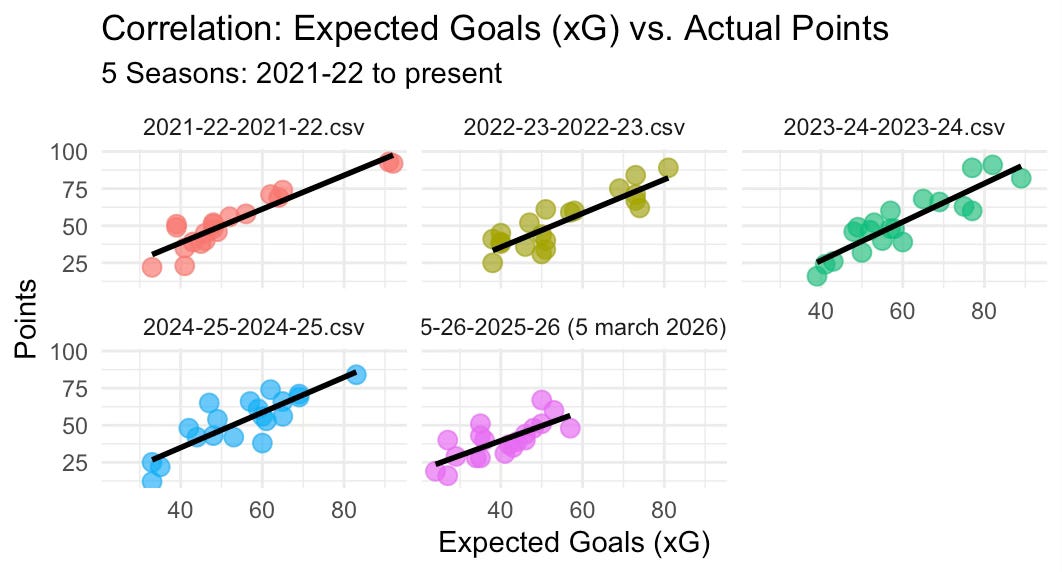
To put some substance to this claim, I looked into something relatively straightforward: Over the past 5 Premier League seasons (including this current season to date), how strong is the correlation between xG and points? As you can see here, it’s very strong!
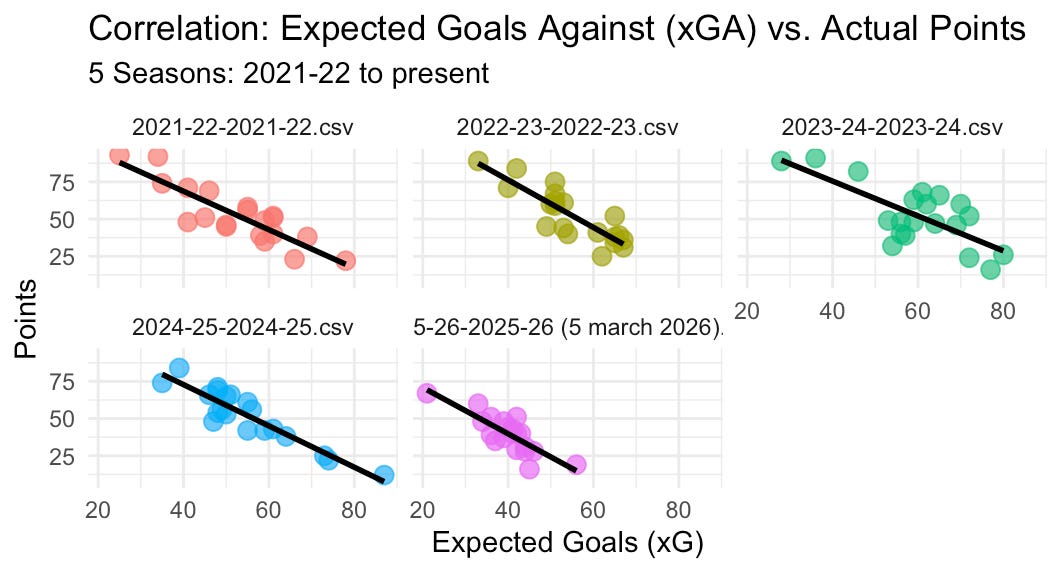
Now, you might say, but what about the correlation between low xGA and points? And you’d be right to think it’s also very strong:
But here’s where it gets interesting, at least as I see it. In the graph below, I plotted the correlation of xG and points (green bars) for each of the last 5 seasons (including this one to date) alongside the inverse correlation of xGA to points. I’ve given you the correlation coefficients as the differences are extremely small (and a correlation coefficient of .7 or above typically indicates a strong correlation between two things). As you can see, in 2021-22, 2022-23, and 2023-24, creating a high xG correlated slightly more than giving up a low xGA with points. Last season and this season, however, it flips, and defending correlates slightly more with points:
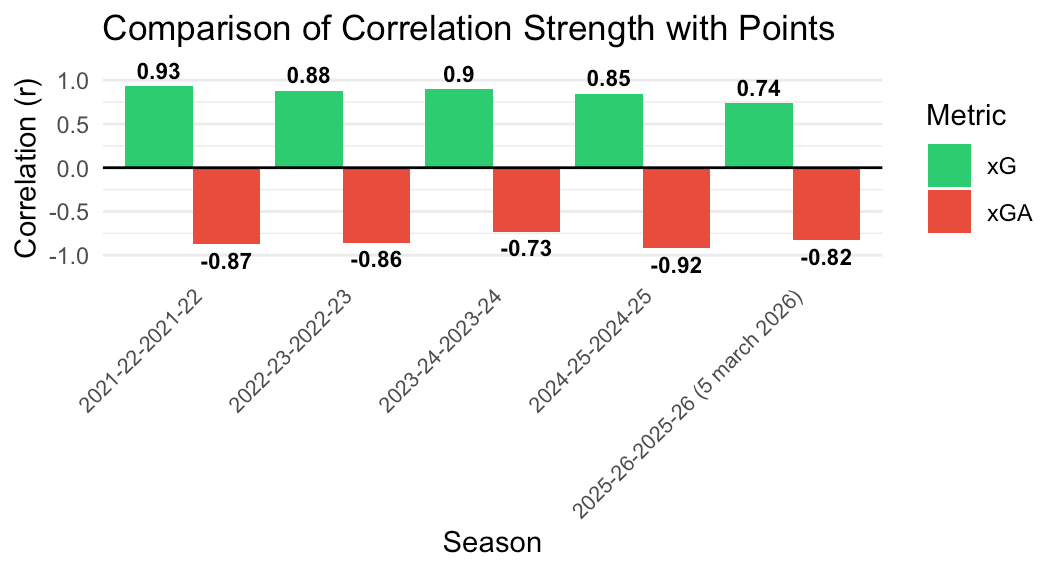
The differences are so small that the ‘flip’ doesn’t mean much here, but foremost what this simple analysis shows is that good teams are generally good at both attacking and defending; both actions are more likely to get you more points. That’s obvious, I know, but I think it’s important to establish statistically because of what I want to say next.
It’s a timeless debate about whether attacking or defending is the more important thing to do to win. In reality, the best teams do both really well. But you could also ask whether they do both really well because one thing is the better enabler of the other.
In other words, which is more plausible:
Teams that focus on defending and defend well create high xG by virtue of defending well.
Teams that focus on attacking and attack well yield low xGA by virtue of attacking well.
My view is that the latter is easier to justify. When you have the ball far away from your own goal, it’s harder for your opponent to attack. When you’re creating a lot of chances, you’re forcing your opponent to focus on defending, making it harder for them to develop attacking moves and push players forward.
You could argue the reverse—that, in short, counterattacking from a successful defensive setup generates lots of chances it wouldn’t otherwise—but if you look at the top teams in the Premier League each season you don’t see counterattacking profiles; you see not only high xG and low xGA but also high possession, high territory, high touches in the opposition penalty area, and so on.
This doesn’t mean defense-first sides can’t be successful. They’re just much less likely to do so, and also more reliant, I think, on overperformance. Forest last season were a good case in point: they radically overperformed xGD, and now that they’re no longer overperforming at that rate, they’re in a relegation scrap. Sides that try to ‘first raise the defensive floor’ don’t exist, because attacking well is a big part of defending well.
Attacking is good, actually. We should start doing it again.
The particular hubris at work in Spurs’ situation is not that of a ‘big club’ like Spurs thinking we’re too big to go down. It’s the hubris of Premier League exceptionalism, the idea that the Premier League is so special that it defies the fundamental laws of football, therefore the only way to succeed in it is to chase the holy grail of ‘Premier League experience,’ even if it’s the experience of mediocrity and desperation, i.e. the experience of what’s widely called ‘pragmatism,’ which should just register as an epithet at this point. What matters about Ange, or Frank, or Tudor is not whether they have Premier League experience, but what they’re trying to achieve and how they’re trying to achieve it.
I don’t know what Tudor has in mind. It’s hard to draw conclusions so early, even if the reality is that unfortunately we don’t have much time to ponder. If he’s working toward some kind of attacking intent based in possession—at this point we don’t need to have City-level possession, just the intent to do more with the ball than smash it long—then Spurs will be OK. If not, the club should get someone in—anyone, really—who can set us up to play possession, attacking, territorial, control football. Protagonist football. Main character football. Not bit part football, cameo football, surrender football.
What stands between Spurs and safety isn’t player ability or attitude. It’s the impetus and structure to use the ball like a real football team for whom an 8th place League finish used to be a bad year, a team that’s been in more Champions League competitions in the last 12 seasons than Arsenal and Manchester United, a team that just brought home a European trophy a few months ago. That’s who we are. That’s still who we are. And even if club executives have forgotten that, even if the players are struggling to remember it, we the supporters have the luxury of enough critical distance to hold this in mind and never let it go.
God i miss Ange.
With nine games to go, we don't need Grand philosophy. We just need points. And normally I would say that defensive, compact, well organized football is THE WAY a weak side gets some points. But we've tried that. Tried it with Jose, with Nuno, tried it with Conte, tried it with Frank. And it has always led to disappointing results. I don't know why, but it's clear: It's not who we are, mate.