
There Is No Magic Manager
Perhaps Spurs have already squandered the competitive advantages we built.

I like Ange Postecoglou. It’s no secret among regular readers of this Substack that I have a lot of time for him. But it’s also no secret that the league results this season are unacceptable, causing many Spurs fans to start imagining life with a new manager.
Probably the most sought-after manager in European football right now is Bournemouth’s Andoni Iraola, whom reports have already begun linking with Spurs.
Iraola’s Bournemouth sit 10th in the Premier League table—ahead of 14th-place Spurs—yet are one of only 4 Premier League teams to have taken fewer points than Spurs in their last 5 games:

Nevertheless, the buzz is all around Iraola, and the familiar machinations of grass-is-greener mentality have already set to work on our psyches. Iraola plays with similar running and intensity figures to Postecoglou, leading a Bournemouth squad who’ve had injury problems aplenty, but the thinking is he’ll add a degree of pragmatism and tactical dynamism to Spurs that Postecoglou lacks.
It’s easy to romanticize what might be when compared with what already is, but I’d argue that, besides wishful thinking, two important forces are in play once Spurs fans start fantasizing about a new manager who can come in and lead us to the promised land.
Sacking the Manger as The Only Tool in the Shed
The executive leadership at Tottenham Hotspur have been playing manager roulette for a long time now. Since Pochettino, hired in 2014 and sacked in 2019, Spurs have had 6 managers—4 of whom permanent hires (as opposed to caretakers after a mid-season sacking)—in 6 years. If you exclude the current manger, since we don’t know if he’ll be sacked at season’s end after a customary (for Spurs) 1-2 seasons, it’s 3 managers, plus 3 caretaker stints covered by 2 more managers—5 persons in total—in 4 years.
We don’t need to rehash each of these stories to understand that, as an executive leadership strategy, Spurs have made scapegoats of managers in quick succession after the club failed to build on Poch’s success.
As a consequence, the club has conditioned its fans to expect a manager sacking when results turn sour or otherwise fall short of expectations. This in turn creates an environment around the club and within the fanbase in which replacing the manager can seem like the only possible solution to a footballing problem.
By analogy, if the club is a house, we may have a leaky faucet, some electrical problems, a partially collapsed foundation, and a few broken windows, but our heads of household have convinced us that they only have—and need—one tool, a burlap sack, to fix everything. No hammers, no sanders, no cement mixers, no nail guns, no electrical tape. Just the sack.
Of course, Spurs aren’t the only Premier League team to operate this way. In the English game in particular, the managers are the figureheads—the CEOs of the pitch side and the press conference—and often face the sack even when other problems at the club have perhaps a greater impact on results.
That said, if you look at the teams at the top of the Premier League table, as well as those who’ve managed to get promoted in recent years, avoid yo-yoing between the Prem and the Championship, and build themselves into perennial Premier League competitors—you’ll find a strong correlation with the list of longest-serving managers. Here are the 5 longest-serving Premier League managers:
Pep Guardiola (defending champion, 5th place)
Thomas Frank (turned a promoted team into PL staple)
Mike Arteta (2nd place)
Marco Silva (turned a promoted team into a PL staple)
Eddie Howe (7th place with 2 games in hand, 3 points off 4th)
Of course, newcomer Arne Slot has Liverpool top of the table, but that’s in large part because Liverpool’s previous manager, Jürgen Klopp, left on his own terms, allowing the club to manage succession planning well in advance of when clubs usually do, after Klopp managed with remarkable stability for nearly a decade, winning league and UCL titles.
The point here is not only that success enables longevity—you’re not compelled to fix what isn’t broken—but also that longevity enables success. Almost every manager at the top of the longest-serving list has had disappointing seasons during which club and fans flirted with the idea of making a managerial change. And in almost every case, each of these long-serving managers has delivered according to or in excess of expectations, whether that’s a treble (Pep), UCL football (Howe), becoming regular title challengers (Arteta), or pushing into the top half of the Premier League within 4 years of promotion from the Championship (Silva, Frank).
So, one force that’s bearing down on Spurs and Spurs supporters right now is our recent history of sacking the manager as the only problem-solving tool the club allows itself to use. That means whatever problems we encounter as a club, however we explain them, we only have one solution, whether or not it solves any of the problems (the lack of silverware since 2008 would seem to indicate that in fact sacking manager after manager is not solving any of the club’s footballing problems).
The Rise of the Tactico
The other force bearing down on Spurs, in particular, is that pundits, journalists, and fans alike have begun seeing the beautiful game in a new way.
It’s not that tactics themselves are ‘new’—far from it—but that in recent years we’ve witnessed an explosion of tactical explainers and explanations made accessible to the average fan. You can now read any number of articles on The Athletic, or tune into any number of football podcasts, and hear people talking an increasingly common language: low-block; counter pressing; rest defense; high line; automations; rotations; pressing triggers; buildup play; etc. This is the mainstreaming of football tactics.
Often we lump these tactical terms together with analytics terms such as xG, field tilt, PPDA, and the like, but that’s a mistake. Tactics and data analytics can play off each other, bolster the case for one another, etc., but they aren’t the same development; sometimes even they’re in conflict (i.e. when a data-based explanation and a tactical explanation don’t align).
In my opinion, the rise of the tactico and the mainstreaming of football tactics—that these are now relatively accessible to broad audiences—are good things. For me, at least, they add a lot to how I experience a football match as a fan, both expanding and enriching what I can appreciate about the game. Plus, tactics are just fun to chat and argue about.
However, there’s a potential downside to the mainstreaming of tactics and tactical explanations, which is that their current prominence can lead fans and other laypersons in particular to overestimate the impact of tactical choices on match outcomes.
Put another way, football is beautiful in large part because it’s a notoriously chaotic game, a game in which you can dominate virtually every facet and still lose on the haphazard bounce of the ball. For this reason, football is one of the hardest sports to bet on, i.e. to systematically predict. This doesn’t mean tactics are useless—indeed, tactics are important for footballing success—but rather explaining, thus predicting match outcomes is extremely complex and multi-conditional.
The Myth of the Magic Manager
And this brings us back to where I started, with the dilemma it looks like Spurs are facing over the future of Ange Postecoglou, and the budding speculations about what a hyper-hyped tactico manager such as Iraola might deliver in North London.
But the reality is there is no magic manager. Maybe someone besides Postecoglou has this Spurs side in 9th or 10th instead of 14th at this point, given the injuries, but Spurs have much deeper problems than the manager, or than the difference between upper and lower mid-table.
Spurs have recently been in the position to overtake Arsenal, with the better part of a decade’s worth of finishing above them, as well as to become regular fixtures in the Champions League and to push into the top 3 the Premier League, challenging for titles. That kind of step up is difficult and sometimes treacherous, which is in part why we’ve slipped back down. But instead of trying to keep climbing the way the elite clubs in the league climb—with smart recruitment and transfer and wage bill investment in large, deep, quality squads—Spurs executive leadership tried to take a shortcut.
That shortcut was betting it all on the manager—first Mourinho, then Conte—without providing the kinds of footballing resources that Europe’s top clubs provide—and that shortcut turned out to be a dead end.
The biggest problem, as I see it, is that Spurs earned a significant competitive advantage over all but the legacy 5 in the Premier League, both on the football pitch in the Pochettino years, and then on the business side with the astute new stadium build and the growing of Tottenham Hotspur as a global brand. But then we failed to press that advantage. And now others are catching up to us.
Despite being the 9th richest football club in the world, Spurs have slipped behind Aston Villa in wage bill, now sitting 7th in the Premier League. Whereas Spurs had begun to close the wage bill gap on Arsenal, Spurs are now over £60 million p.a. behind our North London rivals. Note that wage bill is not some random metic; it’s widely considered one of the best predictors of league table finish. Spurs are now spending a lower percentage of wage bill to turnover (a little over 40%) than Newcastle and Villa—despite being richer than both clubs—and than Arsenal, Chelsea, Manchester United, Liverpool, and Manchester City (chart courtesy of Deloitte):
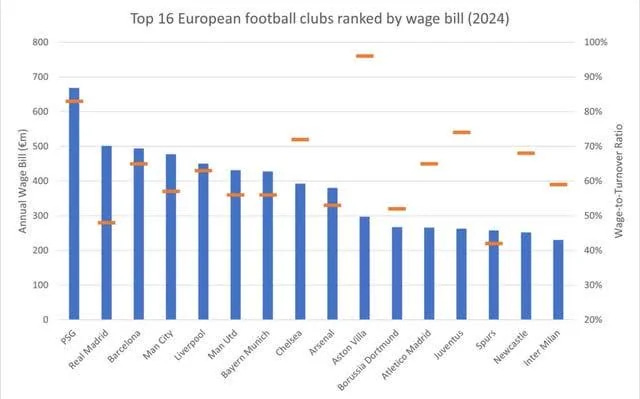
To be clear, what Aston Villa are doing—a wage to turnover ratio of more than 95%—is unsustainable. Spurs should be sustainable. But we can also remain sustainable while spending a healthy amount on wages and transfers that puts us on par with our (aspirational) peers, somewhere in the 50% territory.
We’re talking in relative abstraction here, but how does this translate onto the pitch?
The focus on the manager—and the singular tool putatively at our disposal, sacking the manager—has obscured the extent to which other clubs have caught up to Spurs. Tactics can’t reverse the damage already done.
Meaning Spurs’ poor results this season aren’t only a reflection of injuries and tactics; they’re also a reflection of Spurs having less of a squad quality and depth advantage than we perhaps have in seasons past.
Just having a glance at Aston Villa’s roster, Newcastle’s roster, and even Nottingham Forest’s, Bournemouth’s, and Fulham’s rosters, it’s clear that some of these clubs have surpassed Spurs while others have closed much of the gap.
As a proxy measure of this ‘eye test’ impression while looking at, for example, the fact that Villa can bring on experienced internationals on relatively high wages, such as Marcus Rashford or Donyell Malen, in situations in which Spurs have relied on teenagers and Timo Werner, I took a look at each Premier League team’s share of players in the FotMob top 200 player ratings.
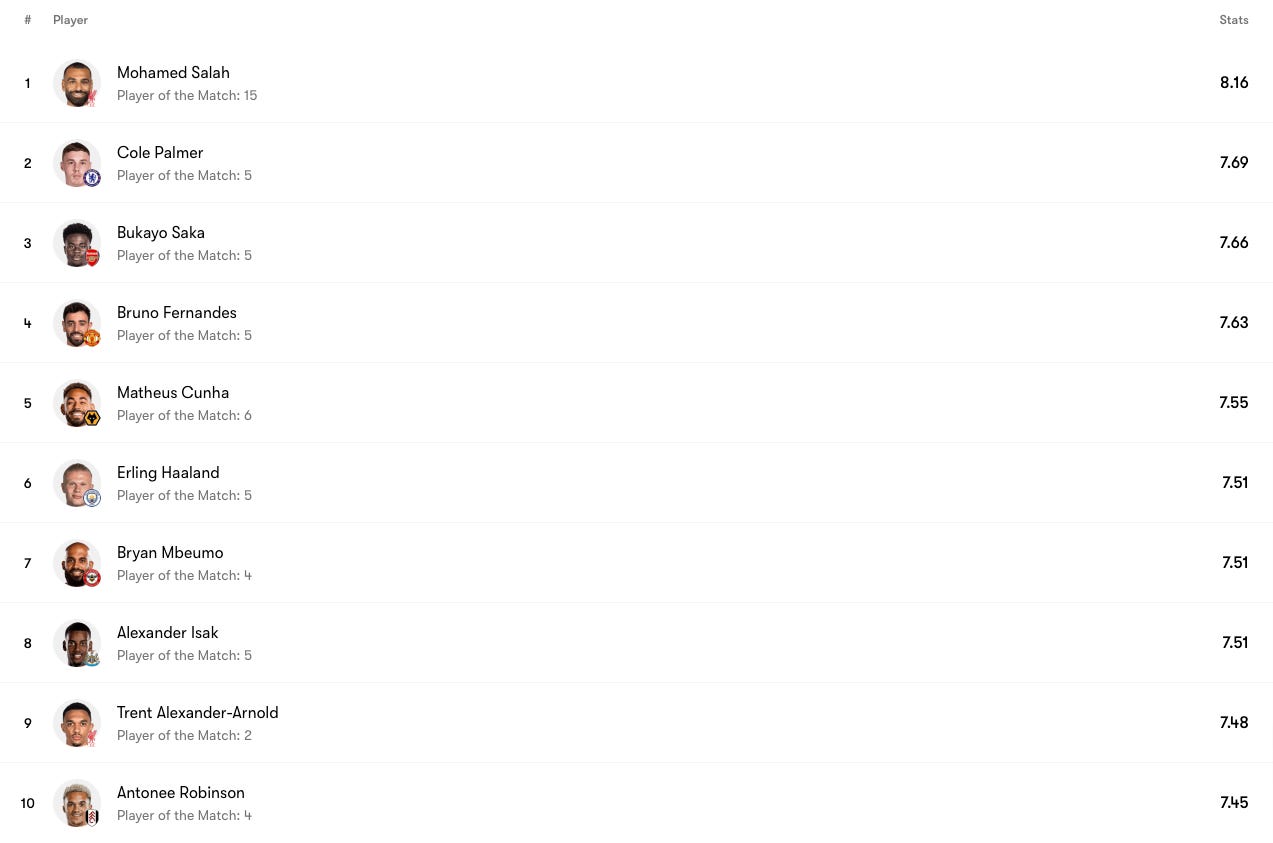
FotMob player ratings are based on the aggregation of lots of Opta stats. It’s far from perfect, but a glance at the list (I include the top 10 below for the purpose of demonstration) should be enough to convince you that the list is a decent measure of what players are contributing, i.e. you’d expect that a player who’s having a good season in real life is getting a high rating:
I made a simple chart of each Premier League team’s share of players in the FotMob top 200 (blue bars) and top 100 (green bars):
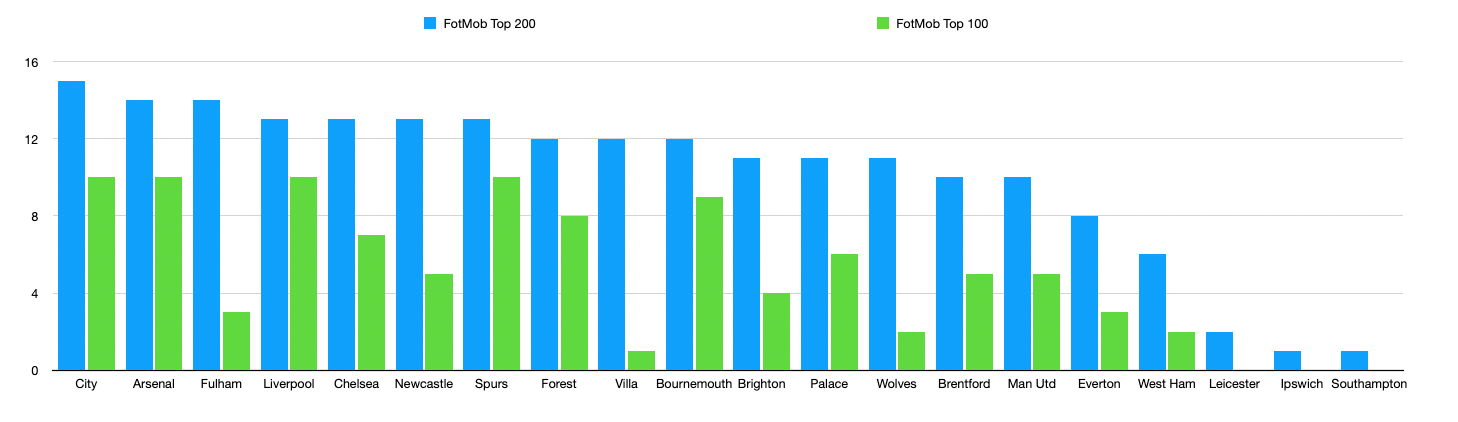
I went 100 and 200 deep in the ratings to capture both the share of particularly high quality players and the share of rotational squad depth (for reference, players such as Lucas Paqueta and Darwin Nuñez are just beyond the 200 mark; Dom Solanke is ranked 198).
As you can see, Spurs are right up there with the top teams in the league (by this metric) in top-100 rated players. With 10 such players, Spurs are even with Liverpool, Arsenal, and City; no one else has more (Bournemouth have 9).
But when you shift to the rotational depth measure—going as deep as the top 200—Spurs’ advantage all but disappears: Fulham and Newcastle narrowly outperform Spurs on this metric, with Forest, Villa, Bournemouth, Brighton, and Palace nipping at our heels.
Putting this in context, when a team in Spurs’ territory suffers long-term injuries to several of their highest-ranking players—with others, such as Micky van de Ven, not even playing enough minutes, due to injury, to feature in the ratings lists—it means something very simple and yet very important is happening: the quality of the actual players playing the games is not so superior as one might think just looking at the squad on paper.
In short, Spurs have played most of the season not only with an injury-depleted squad that isn’t the one Postecoglou would ideally put out with everyone healthy, but also a squad that has little to no quality advantage over the bulk of mid-table teams they’re competing against, such as Fulham, Palace, Brentford, Brighton, and Bournemouth. Spurs playing in Europe and going deep into one of the domestic cups means Spurs are also playing nearly a third more games than their proximal competition, again with no substantive squad advantages over these opponents.
Of course there are caveats to this analysis. You could say, for example, that teams have more or fewer top-200-rated players by virtue of their managers coaching the players they have well or poorly.
Nevertheless, when you take the evidence in multiple forms—the injuries; the relative lack of established, technical, senior pros to emerge from our recent recruitment choices; the declining percentage of wage and transfer spending relative to our peers in the Premier League—I think it’s fair to say an under-considered factor in Spurs’ poor results this season is the possibility that our actually available squad just isn’t that good, at least not relative to the squad gains our competitors have made in recent years. The ambition that clubs such as Villa, Newcastle, Forest, Palace, Brighton, and others are now showing in the transfer market or in wage spending means it’s no longer easy to assume that of course Tottenham Hotspur have a better squad than these other clubs.
This doesn’t mean our squad isn’t promising, that our young players, who look outstanding already, won’t develop into elite senior pros in time. But at 14th in the table, we need clearheaded assessment of what’s going on now, and why.
If you find any of this analysis compelling, then I think you should be careful not to fall for the myth of the magic manager. It may be that Spurs have bigger problems to fix, problems that can’t be fixed by more manager roulette. Foremost among them is that we’ve waited too long to press the advantage we built 5-10 years ago, and missed our opportunity. Accordingly, a ‘painful rebuild’ isn’t just refreshing the squad and finding the right manager; it’s rebuilding the advantage we’ve squandered.
I’m still Ange in. I can’t see any manager being the magical elixir that will do any better. Let’s continue on the rebuild but try and patiently get back to being CL stalwarts rather than shortcutting like Levy is obsessed with doing.
And, as Andy said above, we literally sold Kane and we were, for all intents and purposes, the Harry Kane team. We must keep that front of mind.
Am I right in saying that our top players are good enough to compete with the Arsenals Chelsea Liverpools, but our reserve players are not that far from the Fulhams, Villas, Brightons etc? And when our reserve players play a lot of minutes you end up with this sort of season?
If that is true that is fair but I dont think that would be enough to save Big Ange. For me, when the players came back (from injury) I was expecting a real uptick in performances. It could be that they're just coming back and have to get match sharpness and all of that but the fanbase wont stand for that. The Europa league is one thing but he's really going to have to end the premier league season in spectacular fashion if he wants to keep his job.