
Condescending to Ange
noli me tangere


In a recent Optus Sport interview, Ange Postecoglou said ‘There’s a little bit of pretentiousness and arrogance about people in the Premier League, thinking they’re in a special place…It’s still about football. Whether it’s 1000 Melbourne supporters who aren’t happy with me after the game, or hundreds round the world.’
This was a reaction, not a provocation. For example, Graeme Souness recently called Postecoglou ‘naive and lucky’ in the way he sets up his teams. That’s just the latest and sharpest barb thrown Ange’s way amid a longrunning trend of media portraying his approach to football as ‘naive’ or incapable of working in the Premier League.
The dynamic between Ange and the media is at this point like the old childhood prank of holding a menacing finger just close enough to someone’s face to agitate them without actually touching them, claiming ‘I’m not touching you! I’m not touching you!’ And then feigning innocence when the person you’re antagonizing finally lashes out in response.
In other words, the British football media portray Postecoglou as aloof and ornery, criticizing him for being too honest and too barbed with his responses in press conferences, while at the same time minimizing his accomplishments and throwing him the odd backhanded compliment mixed in with flat-out insults. I’m not touching you! I’m not touching you!
This has all been part of a pattern of condescension toward Postecoglou, who finished ahead of de Zerbi, ten Hag, Pochettino, and Howe in his first Premier League season. So far this season, Spurs have conceded the same number of goals as Enzo Maresca’s Chelsea (with a near identical xGA between the two sides), and fewer goals than Fabian Hürzeler’s Brighton (who also have an xGA of 11 to Spurs’ and Chelsea’s 8). Both Maresca and Hürzeler come the vaunted Premier League from second-division clubs (Leicester City in the Championship and St. Pauli in the Zweite Bundesliga, respectively), and play front-foot football that leaves their sides every bit as open as Postecoglou’s Spurs, if not more so. But these managers don’t endure the kind of condescension Ange gets for coming from first-division clubs in Scotland, Japan, and Australia.
I’ve shown elsewhere that some of the defining features of Postecoglou’s way of playing—the ubiquitously noted ‘high line,’ for example—are not as radically aberrant as the pundits would have us believe. But there’s more evidence to suggest that the condescension with which journalists and pundits treat Postecoglou is more to do with nationalist prejudices and just-so stories about the eminence of the Premier League than Spurs’ actual performance.
For one, Ange’s Spurs finished 5th in the Premier League—not the Scottish Premier League, not the Zweite Bundesliga, not the Eredivisie, but the actual English Premier League—last season. That actually happened. More specifically, 20 teams competed in a league competition, each playing 38 games, and then we added up all the points in the end and ranked each of the teams in what’s known as a ‘league table.’ In that exercise Ange’s Spurs finished 5th, which is higher than Arteta’s Arsenal or Klopp’s Liverpool finished in their respective first seasons.
People will come up with all kinds of reasons to disqualify the actual result of Ange finishing 5th in his first Premier League season, whether by tendentiously chopping the season up into segments of ‘bad form’ or claiming he’d been ‘found out’ after 10 ‘lucky’ matches. But compared with any points projections or notional data we might muster for how things are going this season, we have 38 games of actual data that shows anything but a naive or ineffectual approach to football.
But let’s extrapolate anyway. I’ve already shown that Spurs’ underlying numbers are very good so far this season, better in fact than they were in our undefeated run of 10 games to start last season. As a reminder, underlying numbers, such as xGD, don’t replace an actual accounting of results, but they serve as useful predictors of what’s likely to pan out in the longer run of the season. Spurs’ underlying numbers are such right now that, according to xG models, they really ought to be sitting closer to 3rd than 9th:
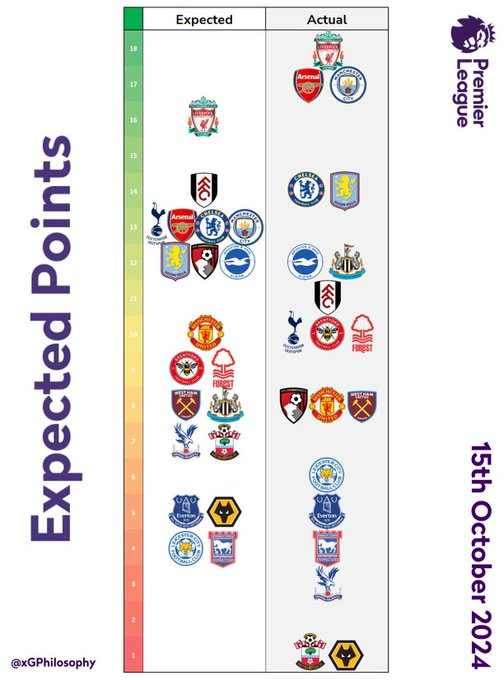
No, this expected points model is not the end all, be all of prediction, but I think it’s fair to say—from the ‘eye test’ as well as the numbers—that Spurs’ performances under Ange this season have been much better than the results reflect, and indeed better than the end of last season, when Ange was allegedly ‘found out.’ When that’s the case—as it was with Chelsea last season, who roared back up to 6th place by the end of the season after stumbling out of the gates—the points are usually forthcoming as the performances and results mutually regress to the mean.
So yes, I do think the ‘Ange is naive and lucky’ talk, and the ‘Ange is too prickly for acknowledging the insults thrown his way’ talk, are significantly down to ordinary prejudice about a manager coming from Asian and Scottish football systems instead of European…errr….the Good European ones.
But I think there’s another facet to this, and it has to do with developing trends in the Premier League itself.
As Jon Mackenzie pointed out, ‘the Premier League is going through a tactical shift,’ characterized by ‘the rise of hybrid pressing incentiviz[ing] quicker build up, and Guardiola’s meta-tactic that elite teams should defend with the ball’ ‘being increasingly questioned.’ In short, as I understand it, Premier League managers are trending toward risk aversion, direct attacking, and counterattacking (see the chart below that accompanied Jon’s tweet):
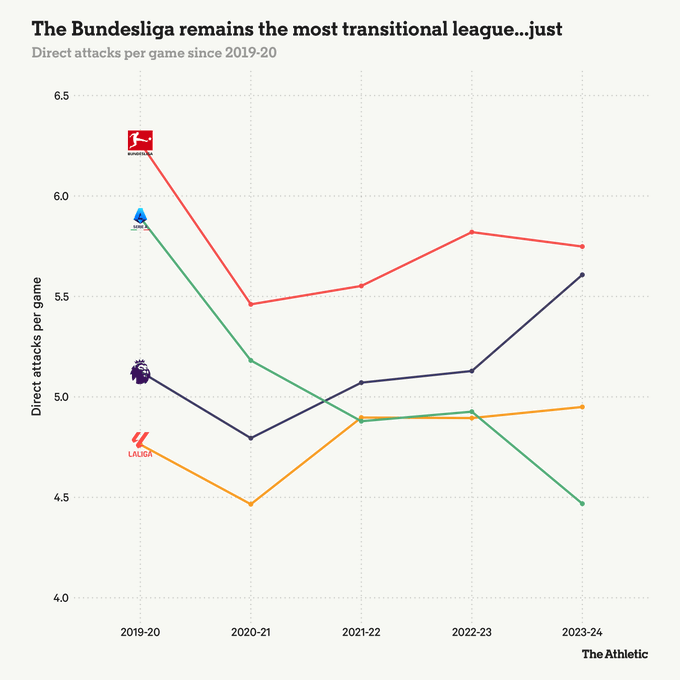
In other words, as we witness a conservative swing in Premier League tactics—perhaps best exemplified by how Arteta’s Arsenal set up this season—systems such as Postecoglou’s and Guardiola’s start to look more out of place than they otherwise would. Of course, Guardiola has long since earned the benefit of the doubt, in particular because of how regularly and situationally he changes his tactics. So of course, Postecoglou, a relative newcomer from too far away for mainstream comforts, gets no such benefit.
What’s important to keep in mind here is that tactical trends are just that—trends. Postecoglou’s way of playing is not violating any kind of immutable laws of footballing nature, contrary to what I’ve seen people claim. Furthermore, because the quality of performance this year, and the underlying data, suggest improvement in what Spurs are doing—especially in ‘defending with the ball’—it makes little sense to assume that bucking the trend automatically means ‘naive football’ or an inability to get results. Again, the evidence we have even just this season so far suggests significant defensive improvement against the top end of the Premier League, even as it appears stylistically aberrant.
I’m obviously optimistic about Postecoglou’s project, but the point I’m making here is not that there are no reasonable critiques of it. Rather, most of the critiques of it that we’re seeing are unreasonable, and they’re unreasonable because they’re rooted in condescension and prejudice more than analysis.